Multifamily 2–4 Unit Home Loans
Buy a duplex, triplex or fourplex, live in one unit, or finance a rental investment. We’ll help you compare the mortgage options for your plans.
Explore My Multifamily Options →Tell us the unit count, location, and your financing goals.
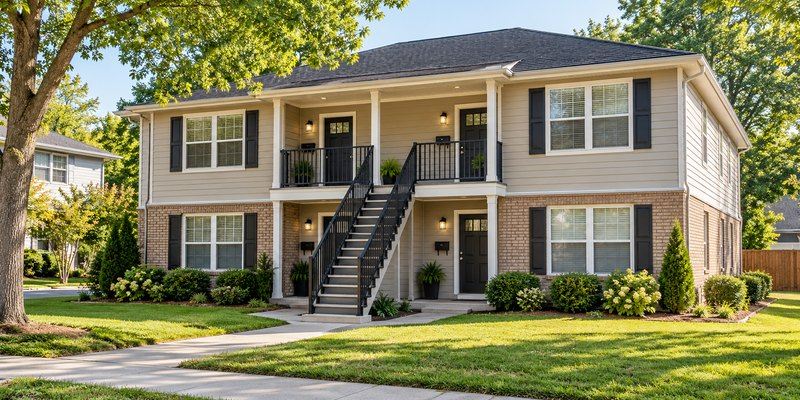
More than one unit. More than one way to qualify.
Multifamily describes the property, rather than one uniform loan product. If you intend to occupy one unit as your primary home, Conventional, FHA or VA financing may fit. If you plan to rent every unit, compare Conventional Investment and DSCR programs. Occupancy changes the available programs, down payment and qualification method.
Start with your plans:
- Buy a rental property with multiple residences.
- Refinance an existing duplex, triplex, or fourplex.
- Explore living in one unit through an eligible residential program.
- Compare personal-income and property-income qualification.
Live in one unit. Rent the others.
A duplex, triplex or fourplex can be your primary home when you genuinely intend to occupy one unit. Eligible rental income from the other units may help you qualify, subject to documentation and underwriting. Compare these three paths:
Conventional
Selected eligible 2–4 unit primary-home purchases allow as little as 5% down. Qualification reviews your income, debts, credit and eligible rental income. Mortgage insurance generally applies above 80% loan-to-value.
Explore Conventional Loans →FHA
Eligible buyers may purchase a 2–4 unit primary home with as little as 3.5% down and a qualifying credit score of at least 580. FHA mortgage insurance applies. Triplexes and fourplexes must also pass an FHA rental self-sufficiency test.
Explore FHA Loans →VA
Eligible Veterans, service members and certain surviving spouses may buy a 2–4 unit home with 0% down when entitlement, value and underwriting support it. You must intend to occupy a unit. No monthly mortgage insurance; a funding fee may apply unless exempt.
Explore VA Loans →Closing costs, prepaid items and required reserves are separate from the down payment. County and unit-count limits, property requirements and program-specific conditions apply. FHA and VA purchase financing are not for a property bought solely as an investment.
Will the rent cover my payment—and help me qualify?
Those are different questions. Your loan officer determines how much documented rental income can be used for qualification. Your household budget depends on the rent you actually collect, minus the property’s costs. A listing’s rent projection is not the same as approved qualifying income or spendable cash.
If you live in one unit, you do not collect rent from yourself. Leases, appraised market rents, vacancies, rental history and the selected program can affect the income the lender accepts. A vacant unit or a new landlord’s limited rental history can change the review.
A triplex budget example
Suppose each unit could rent for $1,600, and you plan to live in one. The two rented units would produce $3,200 a month at full collection—not $4,800. With an assumed $3,500 full monthly housing payment, your household would still contribute $300 before vacancy, maintenance, repairs and other operating expenses.
This illustrates cash flow, not qualification, guaranteed rent or a loan quote. The lender may count a different amount of rental income. FHA’s separate property test may use a different rental calculation.
Rent all units as an investment.
When you won’t occupy the property, the financing follows investment-property rules. The main choice is how you qualify:
Conventional Investment
Qualification considers your documented personal income, debts, credit and assets. Eligible rental income may also count under the program’s rules.
Standard conventional 2–4 unit investment purchases generally require 25% down. Conventional financing does not allow closing in an LLC.
Explore Conventional Investment Loans →DSCR
Selected business-purpose programs focus on the property’s qualifying rental income compared with its housing payment, rather than using a conventional personal-income calculation.
Down payment, credit and rental-coverage requirements vary. Selected options allow eligible LLC ownership. Neither you nor your family may occupy the property under these rental programs.
Explore DSCR Loans →DSCR financing still requires credit, assets, property review and other documentation. Selected options may have interest-only payments or a prepayment penalty; these features do not apply to every loan.
Plan three cash amounts—not just the down payment.
Cash to close includes your down payment, applicable closing costs, prepaid items and escrow funding, reduced by permitted credits and deposits already paid. Required reserves are assets you may need to retain after closing; they are not an additional fee paid at closing.
| Financing path | Down payment | Remaining cash due in this example |
|---|---|---|
| Selected owner-occupied Conventional, 5% | $25,000 | $35,000 |
| Eligible owner-occupied FHA, 3.5% | $17,500 | $27,500 |
| Eligible owner-occupied VA, 0% | $0 | $10,000 |
| Standard Conventional investment, 25% | $125,000 | $135,000 |
| DSCR investment | Scenario-specific quote | Scenario-specific quote |
Planning example only. Each numeric row assumes $15,000 in closing/prepaid/escrow costs, a $5,000 deposit already paid, and no seller/lender credit. It assumes applicable FHA upfront mortgage insurance or VA funding fee is financed when permitted; paying it upfront would require additional cash. Actual fees, financing eligibility, loan limits, insurance and required reserves vary. Reserves are separate and are not included in the cash-due column. A lower initial cash amount does not establish the cheapest loan. Selected financing tiers and all other program conditions still apply; 5% down is not available at every balance or on every property. This illustration does not replace an itemized Loan Estimate.
Multifamily (2–4 Units) Highlights
- Loan amount
- Depend on unit count, financing path, occupancy and the applicable program tier. A selected Michigan investment-property option starts at $100,000, subject to its own eligibility and financing limits. Other financing paths have different minimums; no universal multifamily range applies.
- Credit score
- Selected conventional options with credit scores as low as 620, subject to automated underwriting approval, mortgage insurance where required and other conditions. Investment and alternative-documentation programs have their own credit requirements.
- Down payment / equity
- Selected primary-home purchases: Conventional from 5%, FHA from 3.5% with a qualifying score of at least 580, or VA 0% for eligible borrowers when entitlement and value support it. Standard conventional 2–4 unit investment purchases generally require 25%. DSCR terms vary. Closing costs and required assets are additional.
- Occupancy
- Primary residence when you live in one unit, or investment / rental property. Second / vacation homes are not included in the 2–4 unit options presented here.
- Property types
- Eligible duplexes, triplexes and fourplexes. The legal unit count, condition and appraisal must meet the selected program’s requirements.
- Loan purposes
- Purchase, rate-and-term refinance and selected cash-out refinance. Financing limits vary by purpose and occupancy.
- Rate structure
- Selected residential options include fixed-rate and adjustable-rate financing. The documented rental-income paths reviewed here are fixed-rate; an ARM is not available with every qualification method.
- Interest-only
- Available on selected rental-income options, subject to separate credit and financing limits. Payments can increase when principal repayment begins.
- Amortization / repayment
- Selected rental-income paths document 30- or 40-year structures; selected interest-only options provide 10 years of interest-only payments followed by principal-and-interest repayment. Conventional terms are program-specific.
- LLC closing
- Available on eligible DSCR programs. Entity and borrower requirements apply. LLC closing is not available with the Conventional, FHA or VA options presented here.
- Mortgage insurance / reserves
- Conventional mortgage insurance generally applies above 80% loan-to-value. FHA has upfront and ongoing mortgage insurance. VA has no monthly mortgage insurance, but a funding fee may apply. Selected DSCR options have no monthly mortgage insurance. Required reserves vary.
- Available states
- Michigan, Florida and California, subject to the selected financing path and property eligibility.
Highlights describe different financing paths. Not all features are available together. Eligibility and terms depend on unit count, occupancy, credit, property income, loan amount, state, and lender requirements. Subject to underwriting and program availability.
Send the property details early.
You can start a financing conversation before you have a property under contract. When a building interests you, ask PMF to review:
- The state, county and legal number of units; an advertised ADU or converted space may not establish an eligible extra unit.
- Whether you will live in one unit or rent every unit.
- Current leases, rent roll, vacancies and who pays utilities.
- Available cash for the purchase, closing costs and money retained afterward.
- Known condition issues, repairs and any commercial space.
- Your ownership plan, including an LLC request for eligible DSCR financing.
Share documents through the secure process your loan officer provides. Do not upload tax returns, leases or personal financial documents into an ordinary marketing inquiry.
Check the county and the unit count.
Use the property’s county and its two-, three- or four-unit classification when checking loan limits. A one-unit limit can give the wrong answer. Selected low-down-payment options may change at higher loan balances, and mortgage insurance, reserves and other program conditions still apply.
The building and the borrowing scenario.
- Legal unit count, condition, and residential use.
- Owner occupancy or business-purpose rental use.
- Leases, qualifying rents, and valuation.
- Credit, assets, ownership structure, and requested financing.
Available States
Start a multifamily financing review with PMF in California, Florida, and Michigan.
Availability depends on the selected program and property. Any additional business-purpose state eligibility must be confirmed for that specific financing path.
Multifamily (2–4 Units) FAQs
What counts as a multifamily property?
This page covers duplexes, triplexes and fourplexes. An accessory dwelling unit does not automatically make a home a qualifying duplex; we’ll confirm the property classification.
Can I live in one unit and rent the others?
Yes. Conventional, FHA and VA programs may allow an eligible buyer to occupy one unit and rent the others. Your occupancy must be genuine and meet the selected program’s rules. Reach out to compare.
Can I use FHA or VA if I rent out every unit?
No. FHA and VA purchase financing require qualifying primary-residence occupancy. For a property you plan to hold solely as a rental, ask us about Conventional Investment or DSCR financing.
What is FHA’s self-sufficiency test?
For a three- or four-unit property, FHA separately checks whether adjusted rental income supports the required housing payment. This property test can consider appraised rent from all units, including the unit you will occupy; it does not mean you collect rent from yourself. It does not apply to a duplex and is separate from your personal qualification or a DSCR investment-loan calculation. Contact us for the property review.
Can rental income help me qualify?
Yes, eligible documented rent may help, but qualifying income is different from rent you actually collect or cash-flow profit. You do not collect rent from your own unit. Leases, appraised rents, vacancies, rental history and the selected program affect the review. FHA’s 3–4 unit property test is separate, and DSCR investment programs use their own rental-coverage method. Ask PMF to compare the calculations for your property.
Do I need tax returns or employment income?
Requirements depend on the financing path. Conventional and alternative-documentation options have their own income rules.
How much do I need for a down payment?
It depends on occupancy and program. Selected primary-home options include Conventional from 5%, FHA from 3.5% and eligible VA purchases at 0%. Standard conventional 2–4 unit investment purchases generally require 25%; DSCR requirements vary. Contact us to confirm your options.
Can I buy or refinance a multifamily property?
Yes. Purchase, rate-and-term refinance and selected cash-out options are available. Reach out to discuss how much you may be able to borrow.
Can I close in an LLC?
Yes, LLC closing is available on eligible DSCR programs, subject to entity and borrower requirements. It is not available with Conventional, FHA or VA financing. Contact us to review your DSCR options.
Are fixed rates, ARMs, and interest-only payments available?
Selected residential programs offer fixed rates or ARMs. Selected rental-income programs have fixed-rate and interest-only structures with separate conditions.
Will the lender review leases and an appraisal?
Yes. Rental-income documentation and an appraisal are part of the review. We’ll explain the requirements for your property.
Can a mixed-use building qualify?
A property with commercial space needs a separate review. Contact us before assuming it qualifies for the residential options on this page.
Could a prepayment penalty apply?
Some business-purpose rental programs may include a prepayment penalty where permitted and applicable. Availability and terms depend on the program and state.
What happens after I share my scenario?
A licensed PMF loan officer will review your scenario and discuss possible options. An inquiry is not approval.
Have a multifamily property in mind?
Let's identify the financing path for your scenario.
Explore My Multifamily Options →Program availability and terms depend on your complete scenario and underwriting. This is not a commitment to lend. An inquiry is not a loan approval.